I sometimes read a paragraph over and over again and my brain still feels fuzzed! It is only until I connect with the information that knowledge starts to becomes apparent to the mind. Connection is an important way to learn and that is why I can relate to the theory connectivism as I have to understand something before any learning really takes place. It took me a while to understand the meaning and nature of the theory of connectivism but then I realised I need to to use this theory to understand it! "learning is knowledge transferred from teacher (or book;webpage etc) to student needs to be modified" (The Networked professional,2010) Intelligence is a function of the number of connections learned. The wider connections you have the more you are going to benefit as there are more people which equals more experience. "Connectivism is a learning theory influenced by the spread of the Internet and digital technologies especially social media like web2.0" -Siemens,G.(2004) Being part of this BAPP course this is the way we are learning, we are using digital technologies not only to enhance our knowledge but to gain access to all our work. You can learn via blogging, facebook, web searching, e-mail etc so there are so many sources that are easily accessible that you can gain fantastic knowledge from. Also the web offers opinions,beliefs and perceptions from others which is very helpful as it inspires you to think and go for more.
Thinking back to the last campus session we looked at "nodes" as connection points. Before the campus session I wasn't aware of this mark however after the tube map feature I am fully aware of my current connections even if some of them are in the distance. I am going to increase and develop my nodes for the future as I feel these could be stepping stones to a possible job. The connections I do have I will maintain and nuture to ensure maximum benifit. "Learning is a process of connecting specialized nodes or information sources. A learner can exponentially improve their own learning by plugging into an existing network"
Cerys Dixie quoted that "On the other hand technology can be a very useful tool when it comes to learning. With the vast amount of information available to us we no longer have to experience things for ourselves to be able to learn about them" She is completely right however I feel if we are asked to learn about "how vegetables grow" then you could just type it into the computer and let google do all the work for you. Definitely computers have made our lives easier and a lot more convenient both physically and mentally. Its effortless and saves time but is that what we want in order to be well educated?
"The capacity to know more is more critical that what is currently known. Knowing where to find information is more important than knowing information" http://www.connectivism.ca/about.html
A newspaper would read very differently depending on society, infact there wouldn't be anything to write if it wasn't for us. "The world is of course out objectively out there,but how we come to understand it is a construction or creation of our own making"(The Networked Professional Reader 2010/11) Facebook (for exp) is an absolutely massive intricate network formed due to us.This network is a large social constructivism. Everyone's connections are weaving and interweaving over one another. Everyone has there on individual network however we are all linked in some way. Some people in my network I barely no but I might need them in the future and then a stronger bond in the network will be formed. We make the choices how we want our network to be shaped, we are in control of our own development.Some of my networks don't really exist, if I need it for my professional career I can build it. We have to frame our networks, it doesn't happen naturally,we are the ones who create and form the bonds.
We create meanings, beliefs, inventions that are important aspects to our everyday life's. Nothing would exist if it wasn't for social constructivism and everyday we develop and bring to existence more. One person didn't invent the London eye did they? No social interaction would of taking place,idea's shared and of course social constructivism. "One of it's key principles is that through social interaction, humans "construct"meanings of the world and there experiences of it"(The Networked Professional Reader 2010/11)
Mark Iles mentioned in one of his blogs "I like the idea that in order to fully grasp something you have to make it part of your experience" If you think about it when you are born you aren't christened to be a plumber or an artist, you decide, you make your own future. To find that future you have to pass hurdles and learn from experience. I always think its really strange that maybe I could in fact actually be a world-class jockey, however, unless I experience it how would i actually no? or maybe a lawyer?
Ross Dunning quotes "We can’t just expect our networks to grow and develop by themselves we have to help by constructing them with new contacts, new ideas or new ways of thinking" If i didn't do all the exploring and researching then I wouldn't have a job today. You have to build, develop and maintain to succeed in this hard but rewarding industry!
I'm doing panto over Christmas and in the interval today I decided to get some advise on teaching qualifications from one of the dancers. I was asking her what qualification she has that enables her to feel confident enough but also proves that she is a capable of teaching at a high standard. It took a while to get the conversation rolling as we were both aware that we do teach in similar areas, however when we realised that we both had different ways of teaching and the way we advertise ourselves it became very interesting. The conversation could of been
strategic from her side, and during the conversation I was making choices and calculated what she was saying. Analyzing the conversation cooperation was apparent from the both of us, so I feel we have both aided each other and given the confidence to aim higher in our work.
Sometimes I can be selfish at giving information away for the simple fact that there isn't much work out there and if i felt somebody treading on my toes then yes I would keep quiet. Most of the time I enjoy helping others as I no how hard it is, but I wouldn't keep providing information to a friend who didn't reciprocate.
Game theory is a branch of applied mathematics that is used in the social sciences, most notably in economics, as well as in biology (particularly evolutionary biology and ecology), engineering, political science, international relations, computer science, social psychology, and philosophy. Game theory attempts to mathematically capture behavior in strategic situations, or games, in which an individuals success in making choices depends on the choices of others (Myerson, 1991). After doing some research on the notion of cooperation and analyzing Axrolds (1984) TIT of TAT theory I understand why someone would want to succeed at another person's expense however I believe working as one can be more effective. Researching Robert Axelrod's (1984) theory I have identified that working together with friends in the business and networking with them on a regular basis can develop benefits.
I did play the prisoner's dilemma game involving the principle of tit-for-tat cooperation consisting in interacting in a cooperative mode with a partner as long as he/she does the same.I learnt that imitating another person's moves you are not learning from your own experiences so it is hard to process information. I also fundamentally feel human cooperation and trust works best for me in my professional networking community.
I found a really helpful website which includes the prisoner's dilemma game. The result's of the game are below-
There have been 11001 cooperators (1109 got 2 years and 9892 got 10 years in jail) and 10223 defectors (978 got 0 years and 9245 got 8 years in jail).
I believe your career is like a journey. Travelling along the different paths you meet people that will help you succeed further in work life. In most people's field of work there is an interconnecting system of people, its like a massive spider web.The very popular form of communication is via the web, people are constantly exchanging information and help through this form of network.
When my mum decided I needed to shake of some of my energy she took me to my local dance school, it was my teacher there that was really my first point of network. I didn't even no you could go to a dance college and have a career as a professional dancer. I can remember being stunned at the fact that performing could actually be a job. My web started to grow bigger the day I started Performing Arts college, as I was meeting people who wanted to go into the same industry as me. Actually my very first dance teacher supported me into becoming a qualified dance teacher as without her I would have really struggled. The qualification that I wanted to gain I had to have a teacher(obviously a dance teacher herself) that knew me but also someone who believed that I would be capable of becoming a dance teacher myself.
I went to the last campus session titled "The Networked Professional" I gathered some very interesting information, and I found myself developing my current networks deeper. So for example I went onto facebook and searched my performing friends pages to see what other professional dance groups they were with. This then widens my professional network which increases my chances of being successful. I now understand that my network is constantly moving and changing,weaving and interweaving in different directions. I honestly didn't realise how much I depended on my current networks and what a difference they have made to my career so far. I found it easier to bullet point all my current networks and to have alittle think about how i can enhance them and what possibilities they can bring.
Friends-We make a living by what we get;we make a life by what we give."
-Winston Churchill-
I didn't acknowledge how much i needed my friends for my career. I am constantly calling them for new contacts,help with songs, or even if they know of any jobs available. I am a great believer in making friends as you travel through life not just keeping the ones you grew up with, so alot of my friends are people I have met at training school, jobs or auditions. I feel as long as you help them they will help you, as at the end of the day we all have similar goals and aims. What I keep thinking about is if it wasn't for certain friends of mine I could be in a completely different place. Alan Durrant mentioned on a blog "Part of my professional network strategy is to nurture‘professional friendships’ I really liked this and i agree. Commit and stable a professional friendship,be generous, and you can almost guarantee something will come of it and if it doesn't you always have a good friend.
Social networking sites
I feel like I couldn't live without"certain" technologies for my professional but also my private life. I am constantly interacting with friends within the business and it would be alot harder without this incredible source. Doing this course has made me look more in depth at the possibilities of the wonderful world of web 2.0 and what it can bring to my carear as a performer.
Working for the same employers
I believe it is really important to have a good reputation in my line of work. The dance world really is about "getting your foot in the door"I no it sounds cheesy and obviously you do need to have some talent, but once you are in a network your position as a dancer does feel more settling. I do get a little slack and I do sometimes just assume certain companys will just keep using me but actually a few e-mails will keep the network fresh.
Agent
I learn alot from my agent and he is somewhere in the centre of my newtwork web. He after all is the one who mainly gets me the audions,tells me about casting directors and where my career should be heading. I do feel I should see him more often as talking to someone face to face does produce a better connected realtionship.
Face 2 Face
I always worry about working away (for a long time) as I feel once you are out of the auditioning circuit sometimes you can be forgotten. You forever see the same faces at auditions and classes and you almost start to feel at home. When I got my first job straight out of college I will always remember one teacher saying to me "is it a good idea to leave the country now when you should be getting your face out there to be known" I do have missed opinions about this. The industry constantly changes so you need to keep up to date, also you do need to keep your face known to casting directors but at the same time we all need work and sometimes you have to leave the face 2 face network behind.
Phone
I have invested in a Blackberry phone to enable constant contact with a wide network of people. The amazing creation of the Blackberry means not only can I call someone but I can e-mail,instant message and even facebook people. I never feel alone as all my networks are on my phone!!!
Contacts book/Spotlight
I mentioned the contacts book at the last campus session as being a really good source of information. Most casting directors are in there so what more would you want!
I feel I have a very comfortable and trusting network. Having been in the "performing world" for 6 years I understand you have to be professional and hardworking but always be genuine and true to yourself,never be GOOD friends with someone just for a job! Yes of course there are people in my network that I don't necessary know that well but some of my best jobs have been from the outer circle of my spiders web! Just thinking actually I bumped into Carly (who is doing this BAPP course)in pineapple and we were talking about a certain company that she would never recommend. I feel really thankful that I networked with her on the lst campus session as I then felt confident enough to trust the information she was given me.
I have been spoilt for chose to find a line of inquiry as there are so many questions I want to figure out. The performing world really is a mixture of confusion and mystification and this task will help me learn about a question that has always frustrated me. I was in London this weekend with friend who isn’t a performer and he asked about another friend of mine. I casually told him “oh she is really good, she is leafleting today” he looked at me with bewilderment in his face and asked “why”. Then I was confused and said “she is working” so then we were both frowning in silence trying to grasp if we were on the same page. Then it made sense, why would she be leafleting on the streets in the cold when she is a dancer?
The reason why I have chosen this as my line of inquiry is because this is an area that makes me frustrated and I want to look at other ways a performer can stay in work and feel happy and passionate about there profession. After leaving Italia Conti I went straight into my first amazing contract onboard the Oriana for 10 months however when I got back I felt miserable and generally lost. At college they teach you how to audition, how to perform but do they teach you how to cope with the reality of being unemployed? My answer is not really. When I was at college I was kept in a blissful bubble however valuable information could have taken me into the real world. Rejection, lack of finance and disappointment of not gaining employment has caused a lot of performers in the industry to give up their dream. I do find it funny when people ask me “so what do you do as a career” and I answer “I am a dancer” and they always look at me in admiration which is lovely but do they appreciate how hard our line of work is? Properly not, but then why should they? My favourite line is “are you on TV yet?” it makes me laugh (a little nervy) every time.
The passion I have when I am performing allows me to cope with the distress of looking for work but I do wish there was something we were able to fall back on. When I am in work I am constantly thinking about what my next job is going to be, will it pay the rent, how long will I be unemployed? It is an unstructured way of living; you are always not knowing what and where you will be. Don’t get me wrong it is stimulating and exciting, but I hate not having money and to have money you have to be working. I believe dancers are among the most passionate and dedicated of artists and we rarely take our work for granted.
So I have decided to research and find ways to enjoy getting work, and finding new hobbies!
Work for yourself- Start your own business- it’s the best thing I ever done!
Sell something, make something, do something!
Travel the world!
Exercise- You need to be fit to dance!
Teaching- Teaching is such good money and you are inspiring others!
Do a course- Maybe a BAPP course would be handy for your profession
Do some social networking
Promotional work
Find an agent- seeking out representation
Go to the theatre- get inspired and motivated
“If dancing were any easier it would be called football”
I was walking on the beach in Vietnam a couple of weeks ago with a friend, and just by coincidence we started talking about how people take different routes for their future. Normally your chosen occupation is something you are good at but also interested in. I can remember watching a dance film when I was younger and I can honestly say I didn’t sleep for days after as I just mesmerized at what I saw. I suppose even from a young age (without meaning to) you are reflecting on things you see, hear and that is how we learn. Then as I got older (thank god) I discovered that I was a natural dancer and that was the path I wanted to go down, however many of my friends took completely different routes. Howard Gardner says that “people are intelligent in a number of ways” I feel this is so true. I believe my intelligence is a kinesthetic and also a musical kind and how I found that out was due to my experience.
I am an experienced dance teacher and each day I expand my knowledge due to reflecting on my lessons. Reflection has been a substantial part of my learning and each day I modify my teaching to improve my work. I have made many mistakes at work, but I believe if I didn’t make those errors and reflect upon them then I wouldn’t discover new and better techniques. “Knowledge is not the same as morality, but we need to understand if we are to avoid past mistakes and move in productive directions. An important part of that understanding is knowing who we are and what we can do...” (Howard Gardner 1999: 180-181) Gardner also talks about the idea of Visual, Auditory and kinesthetic learners. I find it hard to concentrate and engage if I am watching something or listening to someone, so I most definitely learn better kinesthetically.
Margaret H'Doubler wrote and spoke about kinaesthetic learning in the 1940s. She defined kinaesthetic learning as the human's body's ability to express itself through movement and dance. I find this very interesting as I am a dancer and I find it easier to learn carrying out a physical activity.
Yesterday I watched a dance class (I was sitting down) and I felt uncomfortable. I was learning very little and I didn’t feel connected to what was happening. I decided to join in and automatically I felt at ease and I gained something from the class. I understand that I am not one type of learner but clearly find I have a predominantly kinesthetic learning style. Tomorrow I have decided to try and use Visual and Auditory learners and I will reflect on how I develop and what I gain from using these styles.
In the arts you are constantly experimenting with ideas and that again is how you learn. I can remember at college me and my tutor was trying to find the best style of singing that suited my voice the best. After we went through Jazz, Rock, Motown etc we decided Musical theatre was my flair! We only found this out by experimental learning and reflecting on what I studied.
John Dewey believes that “if people had full experience and therefore full engagement with their lives they would be better able to be part of society, fully engage with democracy and spend time solving worldly problems” I have faith in this as I feel the more you engage and reflect upon your everyday existence the more you can be involved with society as you have learnt from experience. I read the other day “Thinking is the method of intelligent learning, of learning that employs and rewards the mind”.
The learning cycle
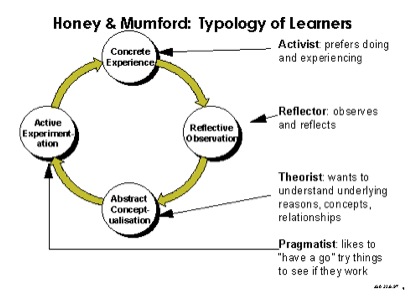
Kolbs learning cycle is very helpful and dynamic as it offers both a way to understand individual people's different learning styles, and also an explanation of a cycle of experiential learning that applies to us all.
Kolb and Fry (1975) argue that the learning cycle can begin at any one of the four points - and that it should really be approached as a continuous spiral. However, it is suggested that the learning process often begins with a person carrying out a particular action and then seeing the effect of the action in this situation.
I watched some video footage of David Kolb explaining experimental learning which I found very interesting.
In the interview David Kolb talks about William James and what he said-
He said that as human beings all we have is our experience, and all knowledge begins in our experience, and the way we know something is true, is that it comes back and proves true in our experience, so experiential learning puts learning in the centre of a learning process. As a learner it’s my experience that guides how I learn and says when I have learnt something.
Its all about experience!
I found this very valuable as you do only no when something is true when you have experienced it. You can only learn when you have experienced it. You are in control of your learning; we are able to create our own experiences. We are at the centre of a learning process, we decide how and when. Everyone is individual; everyone can enter the cycle in a different point depending on what type of learner you are. I really like the “learning cycle” as it’s an organized way of learning!
I feel I enter the cycle at the abstract conceptualization because I am a “thinker” my point of learning something new is when I “work it out in my head first”. I talked to my friend Elizabeth and she said she enters the learning cycle at active experimentation as she believes that trying out what she has learnt is effective. I find it intriguing that everyone goes through all 4 modes of learning but everyone enters the dynamic process at a different point. David Kolb’s opinion is “it’s not the teacher who is the centre, it’s the learner” the focus should be on the learner as it’s the learner who is reflecting on the experience and they need to have the understanding of their observations so they can imply it to their work.
I am constantly reviewing all my classes, auditions and jobs. I really like Peter Honey and Alan Mumford’s four basic learning styles so below I have reflected upon one of my classes (where there was a problem) using this theory.
Having an experience-I get to the school and I realize the class has moved to a different hall. My class is big and can be difficult so all the children would struggle for space.
Reviewing the experience- I notice that the children are moaning, not really paying attention. So I decide that instead of dance we will play games instead. I try and think on my feet but I feel nervous as I feel unprepared.
Concluding from the experience- I start to reflect and I learn that feeling unprepared makes me feel weak. The class isn’t going well and I now realize that I should have voiced that we need a bigger space.
Planning the next steps- I e-mailed the school and said it won’t be possible to do a dance class again in that space. I learnt that smaller rooms could arise again so I need to be prepared with games or a more combined dance if this happened again.
Donald Schon introduced the idea of reflection-in-action, and reflection on-action. I started teaching when I was 16 and panicked if a class was struggling to learn a routine. I would teach slower but I would never change a routine on the spot. After teaching for 7 years I constantly reflect-in-action, I respond to what I see and feel and change it if I need to. I agree with Robert Kottcamp in that reflection-in-action is harder to achieve however the more experience you have the more effortless it becomes. “The actor must simultaneously attend to performing the action and observe and analyze his or her action, as if from an external perspective. Further, in reflection- in- action the actor is the sole collector of data on the event” I guess whilst doing the action you have to observe, reflect, conclude and try out all in one! Reflection-in-action is continually used in our profession as dancers we are use to adapting in seconds. If you were a writer you would use reflection-on-action as you can always go back and source other information at a much slower pace.
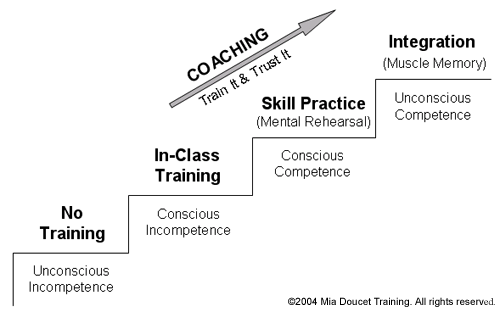
Muscle memory-in relation to Twyla Tharp’s explanation-
When I took my associate to become a qualified dance teacher a big section was on muscle memory. It really is amazing that our bodies retain so much information and can remember movements for a long time. Sometimes when I do a dance I can be thinking about what I am having for dinner as my body will naturally do the steps. I was doing some research on this topic and I found this quote on wise geek which I found attention-grabbing “Musclememory can best be described as a type of movement with which the muscles become familiar over time. For instance, newborns don’t have musclememory for activities like crawling, scooting or walking. The only way for the muscles to become accustomed to these activities is for the baby to learn how to do these things and then practice them with a great deal of trial and error. Gradually, as the baby becomes a skilled walker, he falls less, is able to balance, and finally is able to incorporate other activities into his life such as running”http://www.wisegeek.com/what-is-muscle-memory.htm I like this extract as it gets you thinking “How do I know how to stand and walk” it’s actually your whole body that is involved, with muscle co-ordination and repetition. We don’t tell the body to walk; the body just knows how to do it, largely because neurons communicate with the muscles and say, “walk now.” According to neuroscientists, it’s the movements that become thoroughly mapped in the brain, creating a shorthand between thinking and doing. When I dance I don’t think about each movement individually, it’s the remembrance in our muscles that enables us to do the movements subconsciously. Muscle memory allows us to perform tasks without the same conscious thought that was required the first time we did it.
My blue eyes pricking with tears
Lips desiccated like a dry leaf
Chin quivering with a rhythm of a flapping bird
A lump in my throat ready to burst
Hands trembling with fear
The tears drop like a leaking tap
Salty water fills my mouth
I whisper I need you, I need you now.